Variability hypothesis
The variability hypothesis suggests that men generally have higher variation in traits than women do. So if you take a trait like IQ, you'd expect men to populate a broader spectrum than women for this trait. Note that this theory does not suggest that men, on average, would be any smarter than women; it's not a hypothesis about the mean, but about variance.
What could explain the greater variation in men? As a result of male competition for females, males need to differentiate themselves. How can you compete if you're homogeneous? So there's a mechanism for variability within males that doesn't exist to the same extent in females, resulting in males having a flatter but wider curve than females for certain traits or measurables. It's safer for nature to experiment with the Y chromosome.
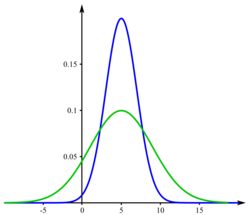
As an easy example, consider that most Nobel prizes are won by men - or that most top chess players are men - and at the same time, men are much more likely to have autism, ADHD or serious reading disabilities. Another example is that the male body simply has a higher ceiling for how much muscle it can build compared to the female body, and that contributes to a larger variation in nearly all physical measurables.
Yes, in the examples there's a lot of room for controversial societal discussion. But I'll leave that aside and simply share how I apply this concept:
I have kids, both sexes. I heard someone compare raising girls to a secure office job and raising boys to a startup, and while I wouldn't be so stark about it, it stayed with me. With boys, there's a higher risk that parenting mess-ups translate into seriously bad outcomes. Most criminals are men, after all.
In the TV series Adolescence, a 13-year-old boy stabs a girl to death. The parents, after the initial shock, start pointing the finger at themselves. Could we have prevented this? Did we cause this? The father looks at their eldest, a seemingly normal teenage girl, and asks:
"How did we make her, hey?”
The mother responds:
“The same way we made him.”
--
I love all my kids equally and seek to provide everyone with all the support and possibilities they could ever need. In other words, I want to maximize the upside for everyone. But I'm just extra careful about the downside with the boys. About who they hang out with. What they do on the screens. Nipping any anti-social behavior in the bud. I reckon it's a pretty thought to say your boys and girls are all equal and your parenting style is the same regardless - and in practice you can treat all your kids the same in a lot of things! - but if you want there to be an equally small chance that you'll have major regrets about how your kids turned out to be when they're older, perhaps you need to treat them unequally in some respects.